
July 11, 2026 · 5 min read · EstateArc
Pre-Construction Marketing in Canada: The Complete Guide for Townhome Developers
How Canadian townhome developers market pre-construction projects in 2026 — buyer experience, broker distribution, pricing psychology, and the tools that actually move absorption.
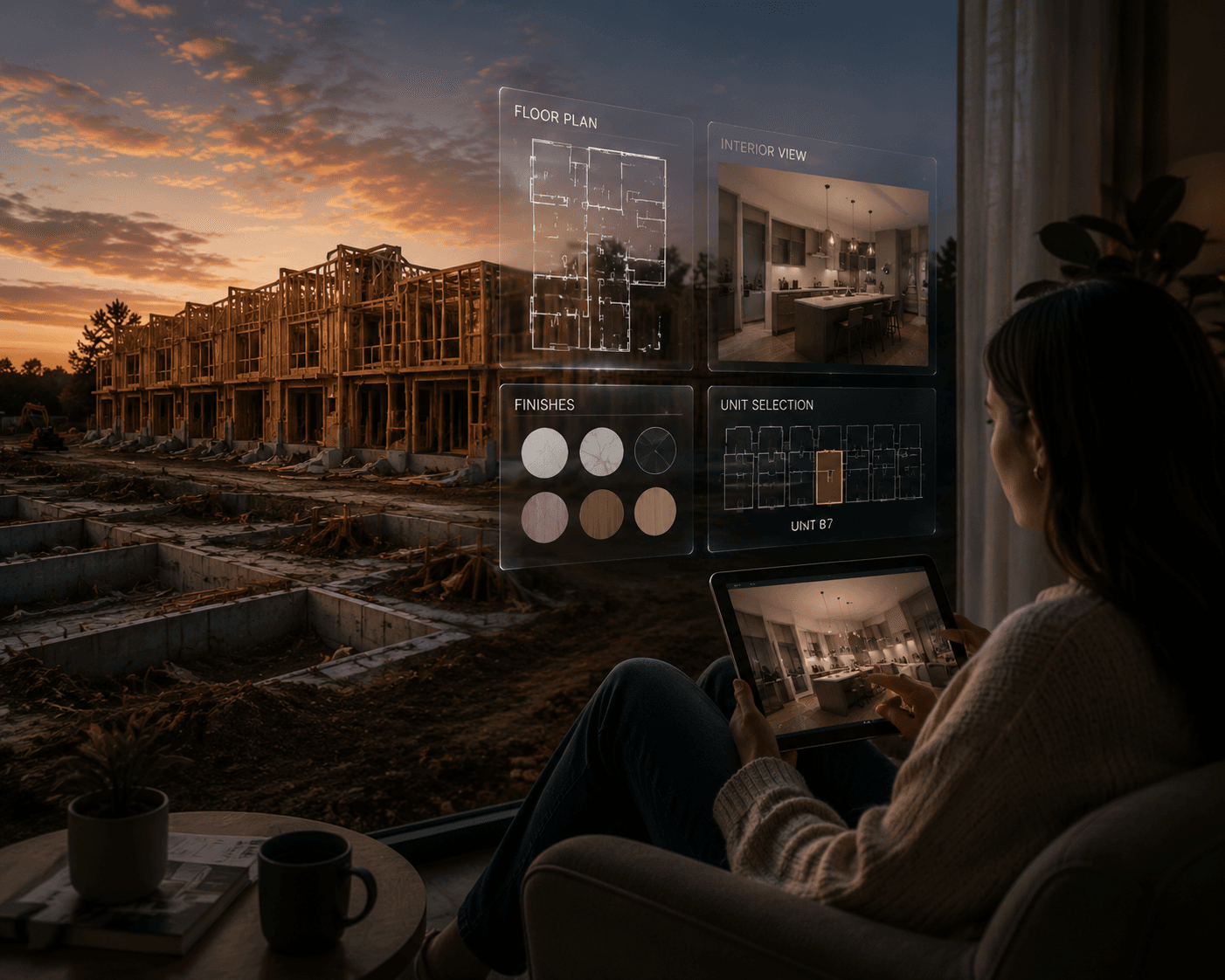
Selling homes that don't exist yet is a different discipline from selling finished inventory. Your buyers can't walk the unit. Your brokers can't show it. Your marketing has to carry the entire weight of the product experience — months or years before anyone can touch a countertop.
This guide covers how Canadian townhome developers approach pre-construction marketing today: what's table stakes, what actually moves absorption, and where launches most often go wrong.
Why pre-construction marketing is different
In a resale transaction, the product sells itself and marketing generates traffic. In pre-construction, marketing is the product experience. Everything a buyer feels about your project comes from what you show them — renderings, floor plans, the sales centre, the website, the broker package.
That inversion has three consequences:
- Visualization quality is product quality. A buyer who can't picture the home discounts it mentally — and expects you to discount it financially.
- Information gaps become trust gaps. When buyers can't see finishes, materials, or warranty details, they assume the worst or delay the decision.
- Distribution is leverage. Whatever you produce gets multiplied (or bottlenecked) by how easily brokers and buyers can share it.
The four channels every launch competes on
1. Buyer experience
Before construction starts, buyers will judge your project on what they can explore. The hierarchy, from weakest to strongest:
- Floor plans and a brochure
- Professional static renderings
- A model home or model suite
- An interactive experience buyers can explore on their own device
Model homes are effective but expensive — often $150,000–$400,000 for a townhome project once land, construction, staging, and carrying costs are counted — and they arrive late, usually after the critical pre-sale window. Interactive 3D experiences deliver the "walk through it" effect earlier and to every buyer, including the out-of-town ones. Most projects pair photoreal interior rendering with a finish configurator to get there — you can see what that looks like in our interactive demo.
2. Broker distribution
In most Canadian markets, broker co-op drives a large share of pre-construction absorption. Yet many launches hand brokers a PDF fact sheet and hope for the best.
The question to ask: can a broker forward your project to a client in ten seconds, and does it look impressive when they do? A shareable, branded, interactive link gets forwarded the same day. A 14 MB PDF waits for the next client meeting.
3. Upgrade revenue
Upgrade and finish programs are often treated as an afterthought — a price list at the décor appointment. That's revenue left on the table. Buyers who explore finishes before signing anchor emotionally on the upgraded home, especially when each option carries the real brand, spec, and warranty. Developers who move the upgrade conversation into pre-sale consistently report higher take-rates.
4. Launch intelligence
Most developers know how many people visited the website. Few know which buyer looked at which unit, how many times, and what finishes they kept coming back to — which is what a live buyer-engagement dashboard is for. That's the difference between a sales call that opens cold and one that opens with "I noticed you kept coming back to the end units."
If you want a structured read on how your launch stacks up across these four channels, our free Launch Readiness Scorecard scores it in about 45 seconds.
The pre-sale timeline: what to have ready, when
| Phase | Timing | Marketing priorities |
|---|---|---|
| Positioning | 6–12 months out | Naming, brand, pricing strategy, target buyer profiles |
| Asset production | 4–8 months out | Renderings, interactive experience, floor plans, website |
| Broker pre-launch | 2–4 months out | Broker package, co-op structure, VIP preview events |
| Public launch | 0–2 months out | Campaign spend, launch event, appointment booking flow |
| Absorption push | Post-launch | Retargeting, engagement follow-up, upgrade program |
The most common mistake: compressing asset production. Renderings and interactive experiences produced in a rush read as rushed — and they're the single thing every buyer and broker will see.
Digital foundations that quietly decide your results
- A fast, indexable project website. Server-rendered pages, proper metadata, and a clean sitemap. If Google can't index you, neither can buyers searching your project name.
- Analytics from day one. GA4 plus per-buyer engagement tracking. Retargeting audiences are built before launch, not after.
- A lead capture mechanism that gives value first. Gated content converts far better when the buyer gets something real in return — an assessment, a finish explorer, a pricing guide.
- Booking friction near zero. Every extra step between "interested" and "booked appointment" costs real buyers.
What "good" looks like in 2026
The strongest Canadian townhome launches we see share a pattern:
- One connected experience — the website, the configurator, the broker link, and the sales dashboard are one system, not four vendors.
- Buyers self-qualify by exploring units and finishes at home before an appointment.
- Brokers get branded links, and the developer can see which brokers actually generate engagement.
- The sales team opens conversations with behavioral data, not a blank CRM record.
That connected approach is exactly what EstateArc builds for Canadian townhome developers — see how the platform works, or book a 45-minute project review to talk through your specific launch.
Frequently asked questions
How far in advance should pre-construction marketing start? For a townhome project, asset production should begin 4–8 months before launch. Positioning work starts earlier — as soon as unit mix and pricing strategy are settled.
Do renderings really matter if the location sells itself? Location gets buyers to look. Visualization gets them to commit. Even in strong markets, buyers who can't picture the interior delay decisions and negotiate harder.
What share of pre-construction sales come through brokers in Canada? It varies by market and project, but broker co-op commonly drives 40–70% of pre-sale volume in the GTA and other major Canadian markets. Distribution tooling for brokers directly moves absorption.
Is a model home still worth building? Sometimes — for larger projects with long sales cycles. But an interactive 3D experience delivers most of the buyer-confidence benefit at a fraction of the cost, arrives before launch rather than after, and reaches remote buyers a model home never will.
Wondering how launch-ready your own project is? Score it in 45 seconds.
Take the scorecardNext step
Book a Project Review
45 minutes, no pitch. We look at how your project is being presented before launch, and you leave with a written summary of recommendations whether we work together or not.
Book a Project Review